
I used to notice something I didn't like about myself and go straight into fix-it mode.
Bad habit? New rule.
Wasted too much time? Delete the app.
Routine fallen apart? Build another one.
Made the same mistake again? Promise myself this time would be different.
For a little while, doing something about it felt good. It gave me that sense that I was back in control.
Then a few weeks later, I'd sometimes find myself right back in the same place.
New plan. New rule. Same pattern.
I've done that more times than I can count.
What I didn't understand was that I'd become so focused on fixing the behaviour that I hadn't properly looked at what was happening around it.
I was trying to repair something before I'd inspected it.
That's why, Curber, growth doesn't always start with fixing.
Sometimes it starts with noticing.
We're Quick to Fix What We Can See
The visible behaviour usually gets our attention first.
You spent money you were trying to save.
You skipped training again.
You lost your temper.
You stayed up scrolling when you knew you needed sleep.
You avoided something important until the last minute.
You said yes to something you already knew you didn't want to do.
So naturally, that's the bit you try to fix.
“I'll stop spending.”
“I'll train every day.”
“I'll delete everything off my phone.”
“I'll wake up at five from now on.”
Maybe that works.
Sometimes changing the obvious behaviour really is enough.
But sometimes it isn't.
Because the behaviour you can see might only be the final part of a longer pattern.
What you did matters. But if it keeps happening, it might be worth looking at what keeps happening before it.
Noticing Means Looking at the Whole Pattern
When I say notice, I don't mean sit around analysing yourself for hours.
I mean slow the situation down enough to see what actually happened.
What happened first?
Where were you?
Who were you around?
What were you feeling?
How tired were you?
What had happened earlier that day?
What were you trying to avoid, get, escape or deal with?
What did you tell yourself just before making the decision?
Not every behaviour will have some deep hidden meaning underneath it.
Sometimes you were just tired.
Sometimes something was too easy to access.
Sometimes your environment made the old behaviour easier than the new one.
Sometimes you hadn't planned properly.
Sometimes there was pressure involved.
And yes, sometimes an emotion was driving more of the decision than you realised.
The point isn't to decide the answer before you've looked.
The point is to look.
I've Built Plenty of Fixes on Top of Guesses
This is something I've had to catch in myself.
I can be quick to build a solution.
Something isn't working and straight away I'm thinking about the new system, the new routine, the new way I'm going to organise everything.
There's nothing wrong with systems.
CFTC is built around them for a reason.
But a system only helps if it's dealing with the problem you've actually got.
If I'm struggling to get something done because the task is unclear, creating a stricter timetable might not solve that.
If I'm staying up late because I've left myself overstimulated and switched on right until bed, simply setting an earlier alarm doesn't deal with what happened the night before.
If I'm avoiding something because I don't know where to begin, calling myself lazy doesn't suddenly give me a first step.
I've had to learn to ask:
What am I actually trying to fix here?
Sometimes the first answer isn't the real one.
Observation Isn't an Excuse
There's another side to this that matters.
Understanding why you did something doesn't automatically make the behaviour acceptable.
You can understand that you were angry and still take responsibility for how you spoke to somebody.
You can recognise that you were exhausted and still admit you didn't handle something well.
You can understand where a habit came from without deciding you're powerless to change it.
Observation isn't about collecting better excuses.
It's about collecting better information.
That's a big difference.
Understanding a behaviour should give you more to work with, not less responsibility for what you do next.
Noticing Isn't Overthinking Either
This one matters for me too.
Because you can take self-awareness so far that eventually you're just standing still thinking about why you're standing still.
That's not the goal.
You don't need to completely understand yourself before you're allowed to change something.
Sometimes the immediate move is obvious.
If something is damaging your life, creating problems for somebody else or clearly taking you backwards, you may need to deal with the behaviour now.
Stop it.
Put a boundary in place.
Remove the easy access.
Apologise.
Ask for help.
Do whatever the situation reasonably needs.
Then, when things are calmer, look underneath it.
Stopping today's behaviour and understanding why it keeps returning are two different jobs.
Sometimes you need both.
Why We Rush Past the Looking
Noticing can feel like you're doing nothing. I think that's part of why it's so easy to skip.
A new routine feels productive.
A new rule feels decisive.
Deleting something feels like action.
Sitting there asking yourself what actually happened?
That doesn't always feel like work.
There's nothing impressive about it.
Nobody sees you doing it.
There's no big transformation to announce afterwards.
But movement and progress aren't always the same thing.
You can change loads of things around you and still keep recreating the same pattern underneath.
I've done it.
That's why I'm becoming less interested in how dramatic the reset looks and more interested in whether I've understood enough to make the next version work better.
Look for What Happens Before
One of the simplest things you can do is stop looking only at the moment you messed up.
Rewind slightly.
Say you've been trying to spend less money, but you keep impulse buying.
Don't only look at the purchase.
What happened before it?
Were you bored?
Did you get paid that day?
Were you scrolling somewhere that kept putting things in front of you?
Had you had a rough day and wanted something that made you feel better for ten minutes?
Were you around people who were spending?
Or did you simply not have a clear rule for what the money was meant to do instead?
Different cause.
Different fix.
The same applies elsewhere.
If you keep missing training because you've scheduled it at a time your actual life rarely allows, the answer might not be more motivation.
If you keep losing your temper after certain conversations, there might be a pattern worth recognising before the next one starts.
If you keep avoiding a piece of work, maybe the first task is too big or too vague.
Notice what happens before.
That's often where the useful information is hiding.
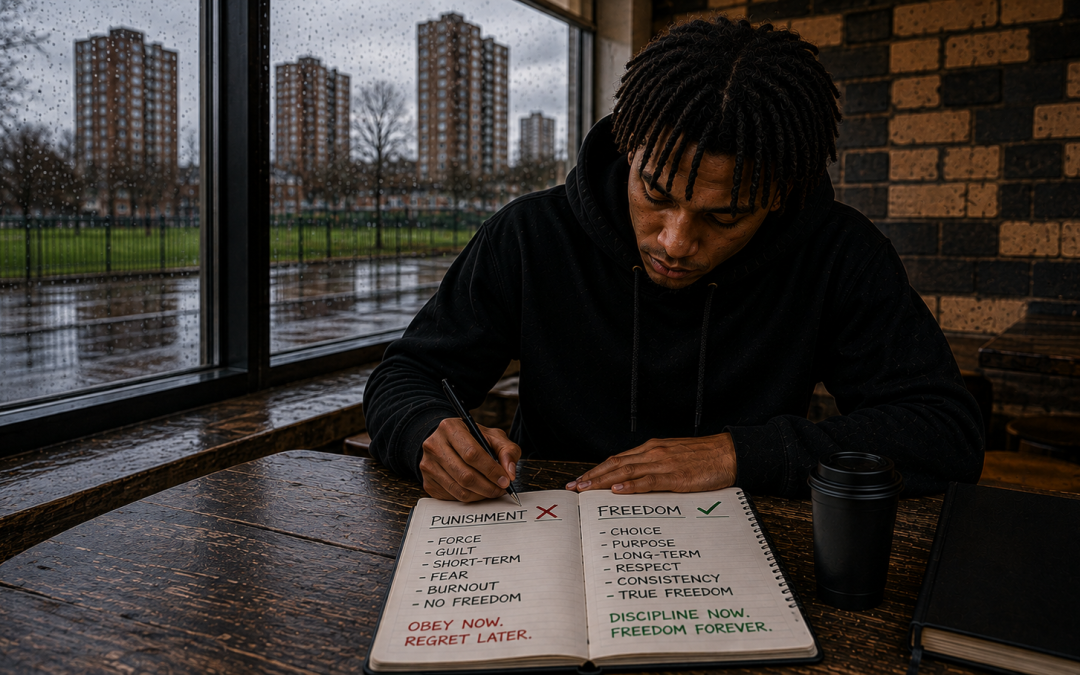
Stop Turning Observation Into Punishment
There's a difference between inspecting your behaviour and putting yourself on trial.
I think we mix those up sometimes.
You look back at something you did and immediately the language starts:
“Why am I like this?”
“I've messed it up again.”
“I never learn.”
“I need to sort myself out.”
Now you're not really observing anymore.
You're sentencing yourself.
And punishment doesn't automatically create understanding.
You can be firm with yourself without becoming hostile towards yourself.
Try changing the question.
Instead of:
“What's wrong with me?”
Try:
“What happened here?”
That doesn't remove accountability.
It gives accountability somewhere useful to go.
The Pattern Might Be Different From the Story
This is where observation can surprise you.
You might think:
“I'm just lazy.”
Then you look properly and realise you work hard in plenty of areas, but keep avoiding tasks where you don't know what the first move is.
That's different.
You might think:
“I've got no discipline with money.”
Then you notice most of your unnecessary spending happens when you're stressed or when you've got no plan for the money after payday.
Again, different problem.
You might think:
“I'm terrible at sticking to routines.”
Then realise every routine you've created assumes every day will go perfectly.
Maybe the issue isn't that you can't follow a routine.
Maybe you've never built one with enough room for real life.
That's why noticing matters.
It can stop you trying to repair the wrong wall.
This Is Why Observe Comes First
Within CFTC, the journey doesn't start with Build.
It starts with Observe.
There's a reason for that.
Before we start talking about discipline, systems, identity and reconstruction, we need some idea of what we're actually working with.
What patterns keep repeating?
What environments bring them out?
What stories are attached to them?
What happens beforehand?
What's actually within our control?
Observation doesn't solve all of that.
It gives us a clearer starting point.
And the clearer the starting point, the better chance we've got of building something that survives longer than the first burst of motivation.
You Won't Notice Everything Straight Away
I still miss things.
Sometimes I only see the pattern after I've repeated it.
Sometimes I think I've understood something, then a few weeks later I realise there was another layer underneath it.
That's normal.
You don't need perfect self-awareness to start reconstructing yourself.
You just need to become a little more willing to look before automatically reacting.
That's the habit we're building here, Curber.
Notice.
Get curious.
Take responsibility.
Then act on better information.
Not every problem needs a deep investigation.
But if you keep applying the same fix and getting the same result, maybe it's time to stop reaching for another patch.
Have a look at the wall first.
Curbwork: Notice Before You Fix
Choose one behaviour you've tried to change before but keep returning to.
Don't create another solution yet.
For now, reconstruct the last time it happened.
Write down:
- What happened immediately before it?
- Where was I and who was around?
- What was I thinking at the time?
- What was I feeling?
- Was I tired, bored, stressed, rushed or distracted?
- What did the behaviour give me in that moment?
- What made the behaviour easy to do?
- What happened afterwards?
Then look over what you've written.
Don't ask, “How do I fix myself?”
Ask:
“What am I noticing that I wasn't noticing before?”
If there's an obvious action you need to take, take it.
But don't rush to build another whole system tonight.
Give yourself a chance to see whether the same pattern appears again.
The aim isn't to stay in observation forever.
It's to make sure that when you do start rebuilding, you're working on what's actually there.