Some things that happened to you weren't your choice.
You might have been let down by somebody who should've been there. You might have grown up around things you had no control over. You might have been treated badly, overlooked, rejected or left carrying weight you weren't ready for.
If something genuinely happened to you, I'm not going to tell you it didn't matter.
And I'm definitely not going to hit you with “just get over it”.
That's not strength. That's pretending.
But there's another side to this conversation that I've had to face in my own life.
Something can be true about your past and still become too powerful in the way you explain your future.
That's where things can get complicated.
Because eventually, Curber, we have to learn how to hold two truths at once:
What happened mattered.
And what happens next still matters too.
You Don't Have to Rewrite What Happened
Personal responsibility doesn't mean pretending everything was your fault.
That's important.
If somebody hurt you, their behaviour doesn't suddenly become your responsibility because you're trying to grow.
If you had fewer opportunities than somebody else, you don't need to pretend the playing field was level.
If your environment shaped how you learned to survive, you don't need to act like you invented those conditions yourself.
Reality matters.
Some Curbers will have had experiences that left a serious mark. Some will still be dealing with consequences they didn't create.
We're not deleting that from the story.
We're trying to work out what authority the story gets from here.
You don't have to deny what happened to stop giving it the final say over what happens next.
Shaped Isn't the Same as Decided
This distinction changed something for me.
My circumstances have shaped me.
Where I've come from has shaped me. Things I've experienced have shaped how I think, what I expect, what I worry about and how I've responded to certain situations.
That's real.
But somewhere along the way, shaped can quietly become decided.
And those are not the same thing.
“This happened, so it affected me” is one statement.
“This happened, so this is how my life has to go forever” is another.
I haven't always noticed when I've crossed that line myself.
Sometimes the explanation has been around for so long that it feels like the conclusion too.
That's where observation comes back in.
Not to argue with the past.
To notice when the past has started making decisions that actually belong to the present.
An Explanation Can Be True and Still Become a Trap
This is where we need some honesty without turning it into judgement.
Sometimes there's a completely understandable reason behind a pattern.
You struggle to trust people because trust has cost you before.
You avoid taking risks because you've seen what happens when money disappears.
You don't speak up because the last time you did, somebody made you regret it.
You expect people to leave because people have.
Those responses didn't necessarily come from nowhere.
But an explanation can describe why something started without automatically proving that it needs to continue forever.
That's the difficult bit.
Because once a pattern makes sense, it can become easy to protect it.
Of course I'm like this. Look what happened.
Maybe that's true.
But the next question is still worth asking:
Is this way of responding still helping me now?
Why the Old Story Can Feel Safer
There's a reason we can hold tightly to old explanations.
They're familiar.
And familiar can feel safer than stepping into something where we don't know what happens next.
If the past explains everything, then in a strange way the future becomes predictable.
You don't apply because people like you don't get picked.
You don't trust because people always let you down.
You don't start because you'll probably fail anyway.
You don't let somebody get close because you already know how that story ends.
There's protection in those decisions.
You avoid some risk.
You also avoid finding out whether the old conclusion still holds.
I've sheltered behind explanations before.
Sometimes I genuinely didn't realise I was doing it.
And I don't think that makes somebody weak.
Sometimes it means they've found a way to protect themselves that worked well enough to survive one part of life.
The question is what that protection is costing them now.
Responsibility Isn't the Same as Blame
This distinction matters massively.
Blame asks who caused it.
Responsibility asks what is mine to deal with now.
Sometimes the answer to the first question isn't you.
The second question can still eventually involve you.
That might feel unfair.
Sometimes it is unfair.
You can end up responsible for dealing with consequences you didn't create.
I don't think there's any point dressing that up.
But refusing responsibility doesn't always return the consequences to whoever caused them.
Sometimes it just leaves you carrying them for longer.
You can refuse the blame and still take responsibility for the part of your life that's in your hands now.
That's not letting somebody else off.
It's trying not to leave them holding the pen to your future as well.
You Don't Owe Anybody a Fake Version of Healing
Taking responsibility doesn't mean you've got to forgive everybody.
It doesn't mean forgetting.
It doesn't mean reconnecting with somebody who hurt you.
It doesn't mean deciding what happened was secretly good for you.
And it definitely doesn't mean performing some perfect version of being “over it” so other people feel comfortable.
Some things take time.
Some things may always be part of your story.
There may be areas where you need support beyond anything an article like this can offer.
That's not what I'm challenging here.
I'm talking about the decisions that are actually available to us now.
The places where an old experience has quietly become the automatic reason we don't even attempt something different.
That's where we can start asking better questions.
Listen for “Because of What Happened...”
One way I've learned to spot the old story is to listen to the explanation I give myself.
Especially the word because.
“I don't trust anybody because...”
“I can't do that because...”
“There's no point because...”
“I'm just like this because...”
The part after “because” might be completely true.
Don't automatically dismiss it.
But once you've heard it, ask another question.
Does this explain my response, or does it have to decide it?
Those aren't the same thing.
Maybe the answer is that you're genuinely not ready to do something differently yet.
Fine.
That's more honest than forcing change you're not prepared for.
But maybe there's one small part of the response that you can choose differently.
That's where some of your power starts coming back.
Taking the Wheel Doesn't Mean Controlling the Road
I like the idea of taking the wheel back, but even that needs keeping grounded.
You don't control the whole road.
You don't control what everybody else does.
You don't control every opportunity, setback, reaction or consequence.
Sometimes somebody else still creates a problem you have to deal with.
Sometimes life changes the route completely.
Personal responsibility isn't total control.
It's recognising the decisions that genuinely belong to you and trying to stop handing those decisions away unnecessarily.
That's enough.
You don't need responsibility for the whole world.
Just your part of the next move.
The Old Story Will Probably Come Back
One thing I'm learning is that recognising an old story once doesn't mean you've finished with it.
Some days I understand something clearly.
Then pressure lands and the old explanation is straight back like it never left.
Maybe you've experienced that too.
You think you've moved past something, then the right situation happens and suddenly you're responding from the same place again.
That doesn't automatically mean you've made no progress.
Sometimes progress is recognising the pattern sooner.
Sometimes it's catching yourself halfway through instead of six months later.
Sometimes it's making one different decision while every part of you wants to repeat the familiar one.
I still have to practise that.
That's why I'm not interested in telling a Curber, “You've got to stop thinking like a victim” and leaving it there.
That's too cheap.
I'd rather ask:
Where has something that genuinely happened to you started making decisions that still belong to you?
That's a harder question.
But it's one we can actually work with.
Your Story Can Get Bigger Without Becoming Fake
You don't need a new story where nothing bad ever happened.
You need a bigger one.
One where what happened remains true without becoming the only truth available.
The old story might be:
“That happened to me, and it changed me.”
You don't have to delete it.
Add something.
“That happened to me, and it changed me. I'm still deciding what I do with what came after.”
That's not denial.
That's reconstruction.
The past stays on the page.
It just stops being the only writer.
What Happens Next Is Built in Small Decisions
Most of this won't happen through one massive breakthrough.
It'll show up in ordinary decisions.
You notice yourself using an old experience as the reason to avoid something.
You pause.
You check whether the danger is still there.
You decide what belongs to now rather than automatically responding to what happened then.
Sometimes you'll still make the old choice.
I do.
Then we notice again.
And try again.
That's the climb, Curber.
Not pretending the past didn't shape us.
Learning where it no longer gets to decide for us.
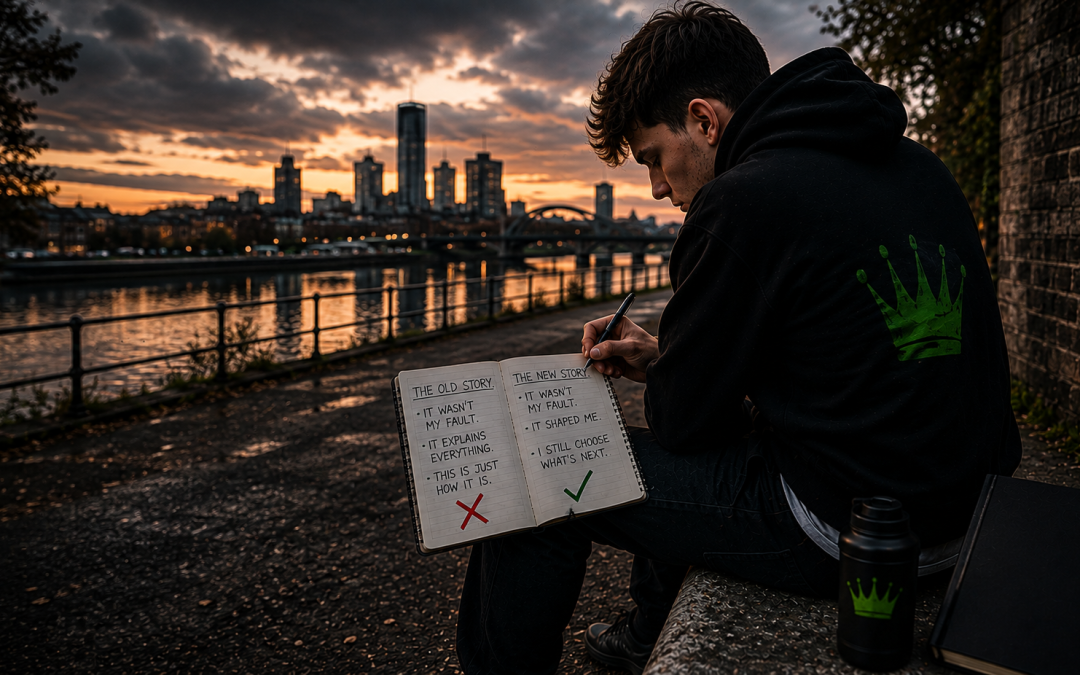
Curbwork: Separate What Shaped You From What Decides You
Choose one experience from your past that still influences a decision you're facing today.
You don't need to choose the hardest thing that's ever happened to you.
Pick something you feel able to look at honestly.
Divide a page into two sections.
At the top of the first, write:
What happened and how it shaped me.
At the top of the second, write:
What still belongs to me now.
Then work through these questions:
- What happened that wasn't in my control?
- What did I start believing or doing because of it?
- How did that response protect or help me at the time?
- Is the same response still helping me today?
- What part of this situation genuinely remains outside my control?
- What part of my next decision actually belongs to me?
- What's one small choice I can make without denying anything that happened?
Don't force yourself to make the story positive.
Don't rewrite the past.
Just separate what shaped you from what still gets to decide.
Then take responsibility for the part that's yours.
That's enough for today.