
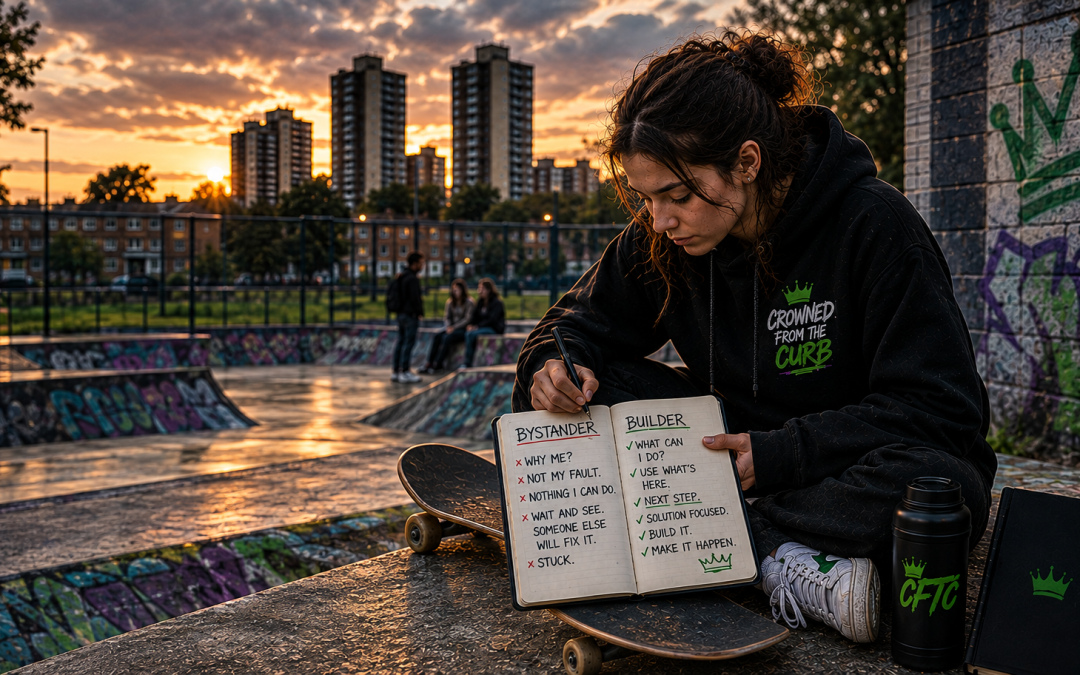
I've spent time on both sides of this.
There have been situations where something went wrong and I immediately started looking at what I could do next.
And there have been others where I've stood there frustrated, replaying what happened, thinking about who caused it and waiting for something outside me to change.
Sometimes I've done both in the same situation.
That's why I don't see Builder and Bystander as two different types of people.
They're two different ways we can respond.
And Curber, when something goes wrong, learning to recognise which mode you're in can change what you do next.
Not because mindset magically controls the outcome.
It doesn't.
But the questions you ask can change what you notice, what you use and whether you take the next move that's actually available to you.
Bystander Mode Can Sneak Up on You
When I say Bystander, I'm not talking about somebody who's weak, lazy or incapable.
I'm talking about a mode I've found myself in plenty of times.
Something happens and your attention gets stuck on everything that's wrong with the situation.
Who caused it.
Why it shouldn't have happened.
What you don't have.
What somebody else should be doing.
What would need to change before you could move.
Some of those observations might be completely accurate.
Maybe somebody genuinely did let you down.
Maybe the situation is unfair.
Maybe you are missing something important.
Maybe you do need help from somebody else.
The problem isn't noticing those things.
The problem starts when noticing them becomes the end of the process.
You can be completely right about what's wrong and still need to decide what you're going to do with what's left.
The Builder Doesn't Pretend the Wall Isn't Cracked
Builder thinking isn't positive thinking with a CFTC name slapped on it.
A Builder looks at what's actually there.
If the wall's cracked, it's cracked.
If the money's short, the money's short.
If somebody messed something up, they messed it up.
If you don't have the skills yet, you don't have them yet.
If you're going to need support, admit that too.
You don't build properly by lying about the materials.
You inspect them.
Then you ask:
“Given that this is where I am, what's actually mine to work with?”
That's the Builder question.
Not:
“Everything is fine.”
Not:
“I can control everything.”
And definitely not:
“I shouldn't need anybody.”
It's simply:
“What's here, what's missing and what's my next useful move?”
You Can Name What's Unfair and Still Build
This connects closely with something we explored in Escaping Victim Thinking Without Denying What Happened.
Responsibility and blame aren't the same thing.
You can say:
“I didn't cause this.”
And still ask:
“What part of dealing with it belongs to me now?”
You can say:
“This opportunity should've been handled differently.”
And still ask:
“What's another route from here?”
You can say:
“I don't have what I need yet.”
And still ask:
“Can I get it, learn it, borrow it, ask for it or build towards it?”
Sometimes the answer will genuinely be:
“There isn't much I can do about this right now.”
That's reality too.
Builder thinking doesn't require you to manufacture control where none exists.
Sometimes the Builder move is waiting.
Sometimes it's asking for help.
Sometimes it's accepting that one route is closed and looking for another.
Sometimes it's protecting your energy until circumstances change.
The point is that you're making that decision deliberately rather than automatically surrendering the whole situation.
Use What's Here
This might be the simplest way I can explain Builder thinking.
Use what's here.
Not what you wish was here.
Not what somebody else started with.
Not what you'd have if everything had gone perfectly.
What's actually here?
Maybe you've got £20 rather than £200.
Maybe you've got one hour rather than a whole day.
Maybe you've got a phone but no laptop.
Maybe you've got somebody willing to give you advice but nobody willing to do the work for you.
Maybe you've got no experience yet, but you've got access to somewhere you can start learning.
Maybe all you've got today is enough energy to make one phone call.
Then that's the material.
Start there.
I think we can lose a lot of time waiting for the version of the situation we think we should've had.
I've done it.
Better timing.
More money.
More confidence.
More support.
More certainty.
Some of those things would genuinely make building easier.
But if they're not available today, the useful question becomes whether there's anything you can build without them yet.
Builders Don't Have to Build Alone
This matters because independence can get romanticised.
Using what's available includes people.
If you don't know something, ask.
If somebody has experience you don't, listen.
If the job needs four hands and you've only got two, find support.
If professional help is genuinely what's needed, getting that help can be part of the build.
There's nothing Builder-minded about refusing useful support just so you can say you did everything yourself.
Communities aren't built by everybody pretending they're self-sufficient.
Good Builders know when they need another Builder.
The First Question Matters
One thing I've started trying to catch is the first question that appears when something goes wrong.
Sometimes mine still sounds like:
“For fuck's sake, why has this happened now?”
Human.
I'm not trying to train myself into some emotionless machine that responds to every setback with perfect wisdom.
Be annoyed.
Take a minute.
Say what needs saying.
But after that, there's another question available.
“What now?”
That question doesn't guarantee a solution.
It doesn't guarantee you'll win.
It doesn't even guarantee there's something useful you can do immediately.
What it does is turn your attention towards the next piece of information you need.
What can I influence?
Who do I need to speak to?
What's still usable?
What's the smallest next move?
Do I need to act, wait, learn, ask, adapt or walk away?
Now you're inspecting the site.
You Can Switch Modes Halfway Through
This is one of my favourite parts of the original Builder idea because I've lived it.
You don't need to respond perfectly from the beginning.
I've caught myself halfway through a proper sulk about something before realising:
Alright. I've been annoyed about this long enough. What can I actually do?
The Builder doesn't have to arrive first.
Sometimes they turn up twenty minutes later.
Sometimes tomorrow morning.
Sometimes after you've already handled part of the situation badly.
You can still switch.
That's important because otherwise Builder thinking becomes another standard we use to beat ourselves with.
“I reacted badly, so I've failed.”
No.
Notice it.
Own whatever needs owning.
Then ask the better question.
You can change your position mid-scene.
Don't Confuse Movement With Building
There's another trap here.
Doing something isn't automatically better than doing nothing.
Builders don't just move for the sake of feeling productive.
If you've ever rushed into fixing something and made it worse, you'll know exactly what I mean.
This is where Growth Starts With Noticing, Not Fixing matters.
Sometimes you need to inspect before you act.
You need more information.
You need to understand what's actually causing the problem.
You need to calm down before having the conversation.
You need to work out whether the thing you're about to repair is even the thing that's broken.
Observation and building aren't enemies.
Good building depends on good observation.
That's why CFTC doesn't start with:
“Do more.”
It starts with:
“Look properly.”
Then build from what you can actually see.
The Next Move Might Be Tiny
I think we sometimes imagine taking responsibility has to mean making some massive move.
It doesn't.
Your Builder move might be sending one email.
Making one call.
Putting £5 aside.
Writing down what you actually owe.
Doing twenty minutes of the work.
Asking somebody how they learned the skill.
Getting tomorrow's clothes ready tonight.
Admitting you don't know.
Apologising.
Changing the plan.
Saying no.
Going home.
Starting again.
The size of the move matters less than whether it moves the situation somewhere useful.
Small materials can still build something.
Builder Thinking Gets Stronger Through Reps
You don't need to wait until your life's falling apart to practise this.
I'd actually start smaller.
Your train gets cancelled.
A plan falls through.
You lose an hour you thought you had.
Something costs more than expected.
Somebody doesn't reply.
The weather ruins what you planned.
Catch your first reaction.
Then ask:
“What's still available to me?”
Maybe nothing needs doing.
Maybe there's an obvious alternative.
Maybe you need to accept the inconvenience and carry on.
That's still a rep.
Because you're training yourself to look for your available move instead of assuming every disruption has taken the whole board away.
Do that often enough and the Builder question becomes easier to reach when the stakes are higher.
From Bystander to Builder
I don't think becoming a Builder means reaching some point where you never complain again.
I definitely haven't.
It doesn't mean you stop getting frustrated.
It doesn't mean unfairness stops bothering you.
It doesn't mean you suddenly know what to do every time life goes sideways.
For me, it's becoming more willing to return to one question:
“What can I build from here?”
Maybe the answer is a full plan.
Maybe it's one small move.
Maybe it's getting somebody else involved.
Maybe today it's simply working out what the problem actually is.
That's enough.
Because Builder isn't a personality type.
It's a position you practise taking.
And every time you take it, Curber, you're reminding yourself that circumstances can affect your options without automatically owning every decision you make inside them.
Curbwork: Find Your Builder Move
Think of one situation that's gone wrong recently.
It doesn't need to be massive.
Choose something real enough that you've been frustrated by it.
First, write down the facts without trying to make them sound better or worse.
Then work through these questions:
- What actually happened?
- What part of this wasn't within my control?
- Is there anything I need to take responsibility for?
- What am I currently waiting for somebody or something else to change?
- What resources, people, skills, time or options are actually available to me?
- What's missing?
- Can I get, learn, borrow, request or work towards what's missing?
- What is one useful move that's genuinely available to me now?
Then finish with one sentence:
“From where I'm standing, I can...”
Don't write what sounds impressive.
Write what's real.
Maybe it's one phone call.
Maybe it's asking somebody for help.
Maybe it's admitting you need more information before doing anything.
Maybe it's starting with what you've already got.
That's Builder thinking.
Not pretending you've got perfect materials.
Learning how to work honestly with the site you're standing on.